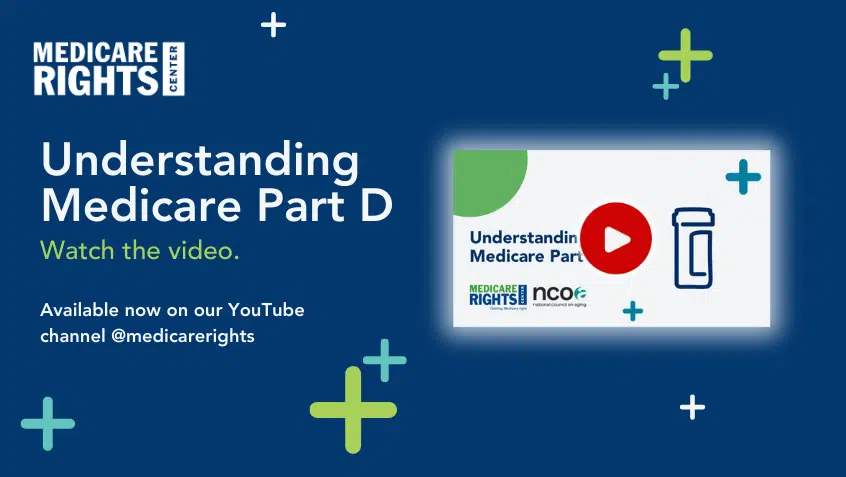
This month, the Medicare Rights Center, with the support of the National Council on Aging, is releasing a new series of videos explaining Medicare benefits and programs. The series is designed to help people with Medicare and those who assist them better understand their coverage options and ways to save on costs. You can view these videos on our YouTube channel.
Part D is available as a stand-alone plan to be added to Original Medicare coverage or included in the benefits of most Medicare Advantage plans.
For most people, the best time to enroll in Part D for the first time is during the Initial Enrollment Period (IEP), as this prevents coverage gaps and avoids the late enrollment penalty. If you have creditable drug coverage through another federal program or your job, you may delay Part D enrollment without a penalty.
Beneficiaries can enroll in a Part D plan if they are already enrolled in Part A or B, and if they live in the plan’s service area. There are various ways to enroll: online through Medicare’s Plan Finder, via phone by calling 1-800-MEDICARE (1-800-633-4227), or directly with the plan through their website or phone number. If you enroll directly with the plan provider, always ensure Medicare receives your official enrollment record.
Additionally, you can add or change your Part D coverage during enrollment periods throughout the year. During Fall Open Enrollment (October 15 to December 7), you can freely make changes to your Medicare coverage, including stand-alone or Medicare Advantage Part D plans. If you are enrolled in a Medicare Advantage plan during MA Open Enrollment (January 1 to March 31), you can switch between MA plans with prescription drug coverage or change to Original Medicare with a stand-alone Part D plan. There are a few additional limitations specific to MA Open Enrollment: you can only make one change during the period, and if you have an MA plan with a separate Part D plan, you cannot change your stand-alone Part D plan.
Outside of these annual enrollment periods, you may qualify for Special Enrollment Periods, during which you can modify your Part D coverage.
The Medicare Part D landscape this year reflects both recent legislation and trends in beneficiary choice.
Certain costs have also been adjusted for 2026. The Part D out-of-pocket cap—the maximum amount a beneficiary may be asked to pay over the year in deductibles, coinsurance, and copayments—is $2,100. The first ten drugs subject to negotiation under the Inflation Reduction Act (IRA) of 2022 will be available at lower costs. The list includes medications that treat serious chronic illnesses like cancer, diabetes, blood clots, heart failure, autoimmune conditions, and chronic kidney disease.
Cost negotiation for additional drugs, with prices to go into effect in subsequent years, is ongoing. However, the passage of HR 1 last summer reduced the efficacy of the IRA provision by broadening an exclusion allowing drugs to be delayed or excluded from Medicare negotiation. This means drugs for certain rare diseases will continue to cost beneficiaries and Medicare much more as a result. Medicare Rights Center continues to advocate for policies that protect access to affordable medications for people with Medicare.
We welcome thoughtful, respectful discussion on our website. To maintain a safe and constructive environment, comments that include profanity or violent, threatening language will be hidden. We may ban commentors who repeatedly cross these guidelines.
2 Comments on “Understanding Medicare Part D and Prescription Drug Coverage”
Kristina Wolf
January 15, 2026 at 5:28 pm
Can someone please tell me why my Aetna part d premium increased this year from 4.50/mo to 54/mo. I’m no math genius, but that seems like an 1100% increase even though I filled few prescriptions last year and none of them changed from the previous year. This is presenting big problems for me. I am on traditional Medicare.
I too had a substantive increase in my premium. It doubled. I am now paying over $90 per month with Aetna. I believe this is true for other Medicare Part D plans because the government eliminated the Medigap for Part D premiums. I only fill 3 medications per month, and one that I have been getting for my chronic illness is now a Tier 3 drug, which makes it very expensive. The drug is very cheap.
More than 67 million people rely on Medicare—but many still face barriers to the care they need. With your support, we provide free, unbiased help to people navigating Medicare and work across the country with federal and state advocates to protect Medicare’s future and address the needs of those it serves.







 Follow Us on Bluesky
2 Comments on “Understanding Medicare Part D and Prescription Drug Coverage”
Kristina Wolf
January 15, 2026 at 5:28 pmCan someone please tell me why my Aetna part d premium increased this year from 4.50/mo to 54/mo. I’m no math genius, but that seems like an 1100% increase even though I filled few prescriptions last year and none of them changed from the previous year. This is presenting big problems for me. I am on traditional Medicare.
Pauline King
July 13, 2026 at 3:30 pmI too had a substantive increase in my premium. It doubled. I am now paying over $90 per month with Aetna. I believe this is true for other Medicare Part D plans because the government eliminated the Medigap for Part D premiums. I only fill 3 medications per month, and one that I have been getting for my chronic illness is now a Tier 3 drug, which makes it very expensive. The drug is very cheap.