Join Us Live for a Discussion on Medicare, Democracy, and the Future of Health Care
What’s at Stake in 2026: The Inflation Reduction Act
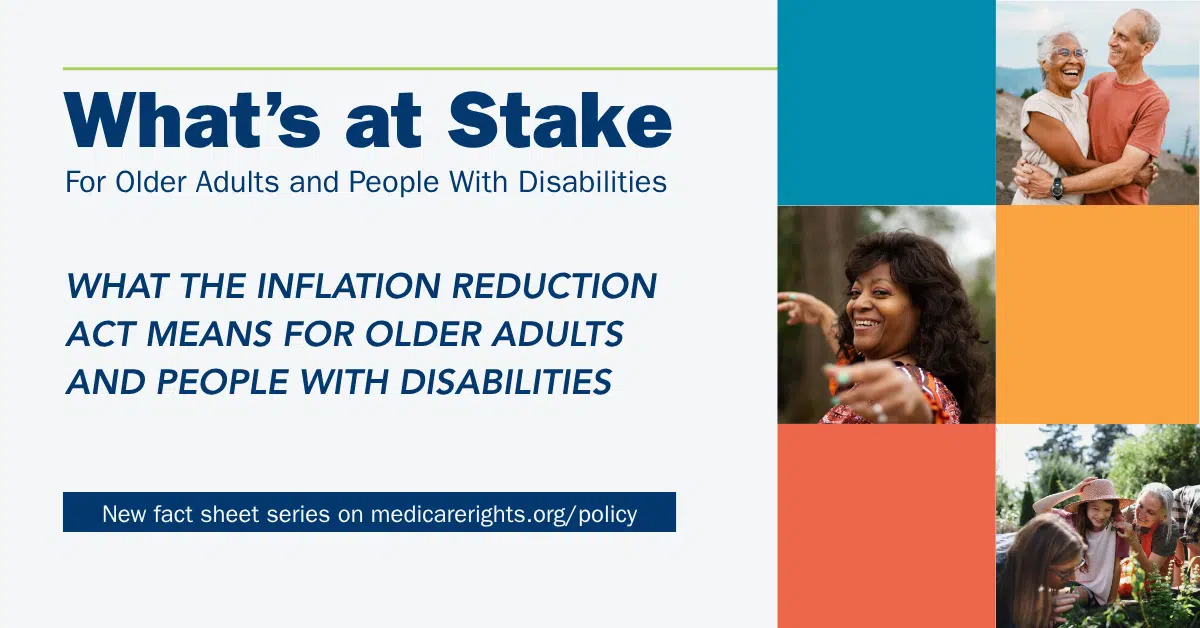
The Inflation Reduction Act of 2022 (IRA) included several key changes to Medicare prescription drug coverage that advanced consumer protections. Prior to the IRA’s passage, there was no hard out-of-pocket cap on Part D costs, no Medicare drug price negotiation, and no mechanism for the government to mitigate drug price increases. The law’s provisions now help Medicare beneficiaries save money by limiting cost sharing and bringing prices down.
The law helps beneficiaries save money by limiting cost sharing and bringing prices down.
Limiting Cost Sharing
Out-of-Pocket Cap and Redesign
As of 2025, Part D has an out-of-pocket cap, indexed annually for growth in costs. In 2026, the cap is $2,100. This change brought the Part D program in line with Medicare Advantage plans, which are also offered by private insurers and are subject to annual out-of-pocket maximums. In addition to the cap, the redesign of Part D created the option for beneficiaries with high drug costs to pay their deductibles and copays in monthly installments, rather than all at once.
Insulin
Since January 2023, insulin costs for beneficiaries have been capped at $35 per month under the IRA. The positive impacts of this were dramatic and immediate: In the first four months of 2023, Part D enrollees between ages 65–74 filled nearly 4,000 more prescriptions per month compared to the last four months of 2022. This was a significant step in reducing the rates at which people ration or forego prescribed medication due to cost concerns. In July 2023, the insulin cost-sharing limit went into effect under Part B, capping copays for Part B–covered insulin pumps at $35 per month.
The positive impacts of capping insulin costs were dramatic and immediate.
Vaccines
Several preventive adult vaccines were also made free for beneficiaries in 2023, including shingles, RSV, Tdap, and hepatitis A and B. As a result, all vaccines covered under Part D now have zero-dollar cost sharing. Data from the U.S. Department of Health and Human Services showed this change improved vaccine uptake and saved Part D beneficiaries over $400 million in 2023.
Bringing Prices Down
Drug Price Negotiation
The IRA put in place a system that allows the federal government to negotiate prices for high-cost drugs that drive the most Medicare spending and meet other requirements, such as having no competition in the market. These include drugs that millions of beneficiaries need to treat cancer, diabetes, blood clots, heart failure, autoimmune conditions, and chronic kidney disease. The negotiated prices for the first set of drugs went into effect in 2026. The drugs selected for the next two cycles of negotiation—to take effect in 2027 and 2028—have also been announced. Early analysis indicates the program is boosting access and lowering costs. The first set of negotiated drug prices is expected to save Medicare beneficiaries $1.5 billion in annual out-of-pocket costs and reduce Medicare spending by $6 billion a year.
Early analysis indicates the drug price negotiation program is boosting access and lowering costs.
Part B Rebate Program
Another federal program counteracting rising drug costs is the Part B Rebate Program, which penalizes drug companies that drive up costs beyond the rate of inflation and allows some Medicare beneficiaries to pay less for rebatable drugs. The IRA sets coinsurance amounts for these drugs based on what the drug would have cost Medicare without price increases that outpaced inflation. CMS determines which Part B drugs are subject to this adjustment on a quarterly basis.
Extra Help Expansion
The IRA expanded eligibility for the federal Part D Low-Income Subsidy, also known as Extra Help. Before the IRA, the program had two benefit tiers, a “partial” and “full” subsidy. In 2024, the IRA eliminated the partial tier, extending the full subsidy’s greater cost assistance to that cohort. Now, the full benefit is available to individuals with incomes up to 150% of the federal poverty level (up from 135%), including to approximately 300,000 people who previously received only the partial subsidy. Everyone with Extra Help now pays a $0 premium, $0 deductible, and a reduced amount for both generic and brand-name drugs.
Now, the full benefit is available to individuals with incomes up to 150% of the federal poverty level.
Many older adults and people with disabilities have few resources. Approximately one quarter of Medicare beneficiaries (16.5 million people) live on less than $24,600 a year and have less than $18,950 in savings. In 2026, individuals with an annual income under $23,940 ($32,460 for couples) and limited resources qualify for Extra Help. For these enrollees, the program—which the Social Security Administration (SSA) estimates is worth about $5,700 per year—can be a lifeline allowing them to maintain coverage, afford medications, and better meet daily living expenses like food and housing.
Current Risks
Though the cost-saving impacts and health access improvements of the IRA are already being seen, the law currently faces several threats to its key provisions. H.R. 1, the 2025 budget reconciliation act, has reduced the efficacy of the drug price negotiation program by exempting more high-cost drugs from negotiation. This is set to increase Medicare spending by at least $5 billion and raise costs for beneficiaries, who will save less than anticipated from the drug negotiation program in premiums and out-of-pocket costs.
The IRA currently faces several threats to its key provisions.
Another concern is last month’s announcement that the Part D Premium Stabilization Demonstration would be prematurely ended at the end of this year. Among its reforms, the IRA restructured Part D in ways that shifted some Medicare cost liabilities onto insurers. Some Part D plans responded by attempting to offload those cost liabilities onto enrollees by raising proposed Part D premiums well beyond initial projections. To address this, the Biden administration created a temporary program to help stabilize rates. Originally begun in 2025 and set to run through 2027, the demonstration was intended to help willing standalone Part D plans minimize financial risk and keep premiums down.
The abrupt end of the demonstration risks enrollees facing jumps in standalone Part D premiums and market disruptions. This could worsen obstacles to affordability and potentially drive people to seek plans that are cheaper but do not fit their needs. It is also possible that plans have absorbed the Part D restructuring, and that any premium increases may be relatively small. Ultimately, the impact is not yet known, as 2027 premiums have not been announced.
The abrupt end of the demonstration risks enrollees facing jumps in standalone Part D premiums and market disruptions.
The IRA introduced several important and effective policies to help Medicare beneficiaries afford their prescription drugs, and its continued efficacy depends on lawmakers who are committed to protecting and expanding these reforms.
View the fact sheet: What the Inflation Reduction Act Means for Older Adults and People With Disabilities.
View the series: What’s at Stake for Older Adults and People With Disabilities.
Show Comments
We welcome thoughtful, respectful discussion on our website. To maintain a safe and constructive environment, comments that include profanity or violent, threatening language will be hidden. We may ban commentors who repeatedly cross these guidelines.
Help Us Protect & Strengthen Medicare
Donate today and make a lasting impact
More than 67 million people rely on Medicare—but many still face barriers to the care they need. With your support, we provide free, unbiased help to people navigating Medicare and work across the country with federal and state advocates to protect Medicare’s future and address the needs of those it serves.
The Latest




Most Read





Add Medicare to Your Inbox
Sign up to receive Medicare news, policy developments, and other useful updates from the Medicare Rights.
View this profile on InstagramMedicare Rights Center (@medicarerights) • Instagram photos and videos
 Follow Us on Bluesky