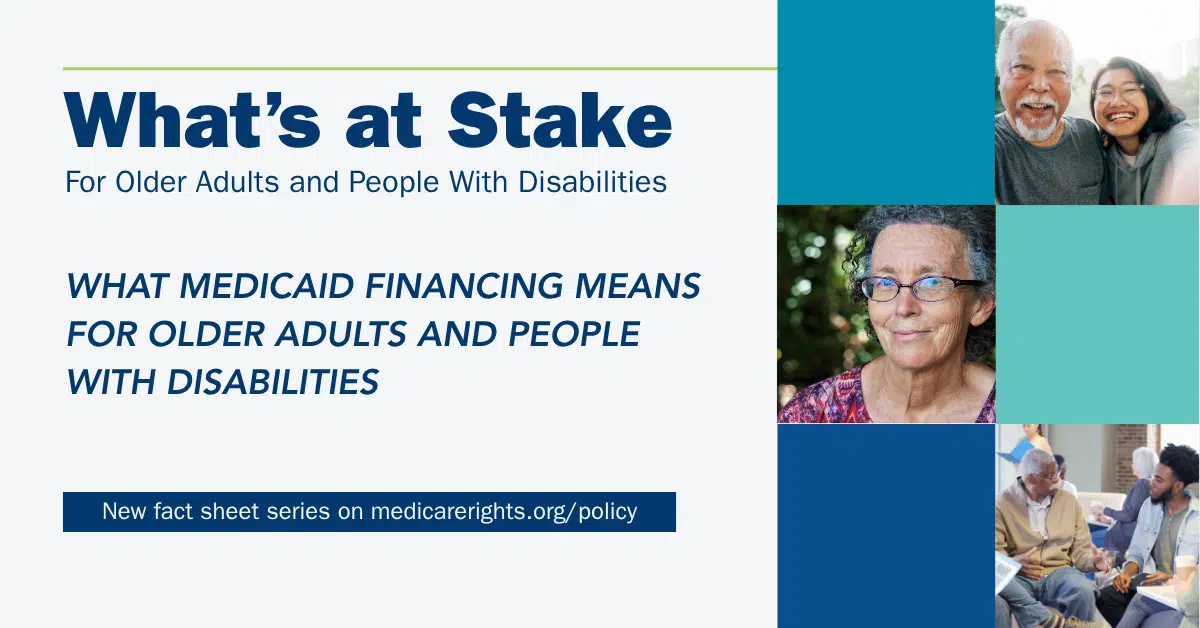
Last year’s budget reconciliation bill, HR 1, included several changes to the ways states can use Medicaid funding. Intended to reduce federal spending on Medicaid, HR 1’s changes will result in sweeping cuts to the program, strain state budgets, and endanger older adults and people with disabilities.
The Federal-State Structure
Medicaid is financed and administered through a federal-state partnership. Federal spending matches state funding in a proportional and open-ended manner. There is no pre-set limit on how much the federal government can spend on Medicaid, which allows the program’s financing structure to adapt to economic downturns or public health emergencies. The federal match and additional state-directed payments allow states to maintain a stable Medicaid program that meets the needs of their residents. But HR 1’s cuts to federal Medicaid funding will dramatically upset this balance.
The federal-state partnership allows the program’s financing structure to adapt to economic downturns or public health emergencies.
A Cut by Any Other Name
Though HR 1’s Medicaid cuts were pushed for and are being instituted under the current administration, the ideas are not new. Some policymakers have been urging more fundamental structural changes to Medicare and Medicaid for years. Two of these proposed changes, block grants and per-capita caps on states, would endanger Medicaid by turning it into a fixed-payment system unable to adapt to changes in cost and demand.
Some policymakers have been urging more fundamental structural changes to Medicare and Medicaid for years.
Under a block-grant system, the federal government would allocate a fixed amount each year for each state to use for Medicaid; the state alone would have to cover any costs beyond that amount. This is an extremely inflexible system that would make Medicaid unable to adapt and respond to natural or public health emergencies that increase the need for care. Once the year’s block grant ran out, the state’s budget would determine the care its residents could receive, exacerbating inequity across states.
Per-capita caps use each state’s Medicaid population to calculate the fixed amount of funding it receives. In order to restrict federal spending, the per-capita formula would either set spending per Medicaid enrollee to a number lower than current rates or limit the rate at which the per-capita allowance grows over time. Similar to block grants, this funding structure would be unable to respond to cost increases outside of population growth.
The people most affected are generally those whose care is most complex and most needed.
States currently offering non-mandatory Medicaid benefits, like coverage of Home- and Community-Based Services, would likely roll back some of those additional benefits to cut costs. Beyond slashing optional benefits, states may seek—with the help of Congress or any presidential administrations that promise to be more permissive about loosening or eliminating coverage requirements—additional ways to reduce spending on services that are currently mandatory. For example, one notable mandatory benefit that drives high state spending is nursing facility care, which Medicaid is statutorily required to cover. A majority of nursing facility residents rely on Medicaid to be the primary payer for their care and facility housing. Changes to Medicaid financing rules may force states to look for ways to tighten eligibility requirements, restrict enrollment, increase cost sharing, or even eliminate the requirement for coverage altogether.
Beyond slashing optional benefits, states may seek additional ways to reduce spending on services that are currently mandatory.
A Way Forward
HR 1’s Medicaid cuts are still being rolled out. Though many of them have not yet taken effect, the early impacts are already disastrous for state budgets, rural communities, and Medicaid enrollees. To avoid further harms, policymakers must reverse HR 1’s cuts and restore Medicaid’s ability to weather economic and public health downturns and provide needed care and support for enrollees.
We welcome thoughtful, respectful discussion on our website. To maintain a safe and constructive environment, comments that include profanity or violent, threatening language will be hidden. We may ban commentors who repeatedly cross these guidelines.
More than 67 million people rely on Medicare—but many still face barriers to the care they need. With your support, we provide free, unbiased help to people navigating Medicare and work across the country with federal and state advocates to protect Medicare’s future and address the needs of those it serves.




 Senate Finance Committee Members Introduce Bill to Reduce Medicare Out-of-Pocket Costs, Improve Access to Medicare Savings Programs




 Follow Us on Bluesky